A long-time member of my professional learning network, Alanna King, posted today about “wrestling with math.” Alanna’s son has found his way into the meat grinder that is math education in most schools, and she is thinking about his struggles in light of her reading of Building School 2.0 (recommended).
We all know the story of the kids who struggle in math. Long nights of homework, tutoring, and some of them never quite become the computational experts their personal computers are. This week I was in a parent-teacher conference with a really top student who excels in all of her classes but is struggling in Calculus class. All that anxiety and stress because she believes (and with good reason, unfortunately) that Calculus is a mountain she must climb in order to get into the college of her choice. The student disclosed in her conference that she wouldn’t be taking the course if she didn’t think it was necessary in the college rat race.
College is a real world goal for students, certainly, but if it is the only reason to take math, it seems like a poor one. Students should understand that math education has a more meaningful purpose, and that purpose should not be math itself. A “siloed” math education divorces the meaning from math and for students who don’t see it as fun, the typical question is “why am I doing this?” Math should be a problem-solving tool for the real world, and education in math should look like that.
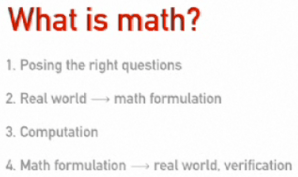 I wrote about this on my blog back in November 2010, and about Conrad Wolfram’s TED talk in which he argues that computers should do most of the computational work of math, leaving the focus on the interdisciplinary purpose of mathematics: http://mikegwaltney.net/math-is-dead-long-live-mathematics/

 Michael Gwaltney